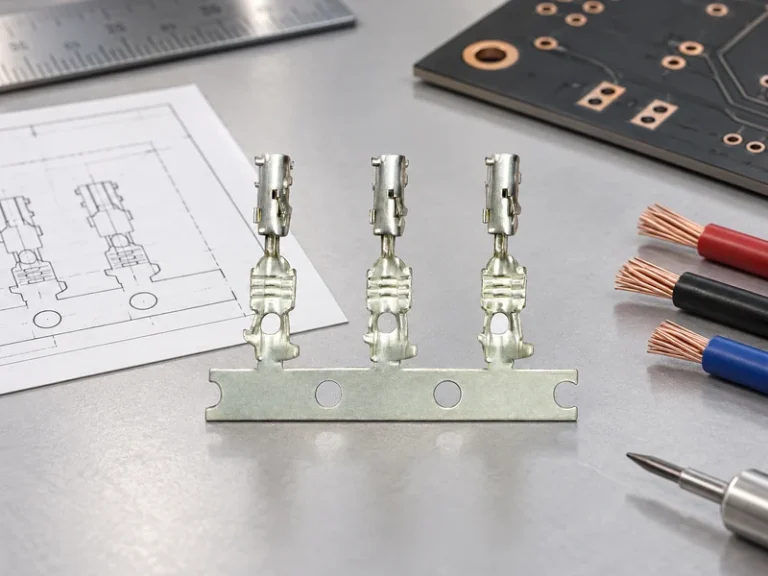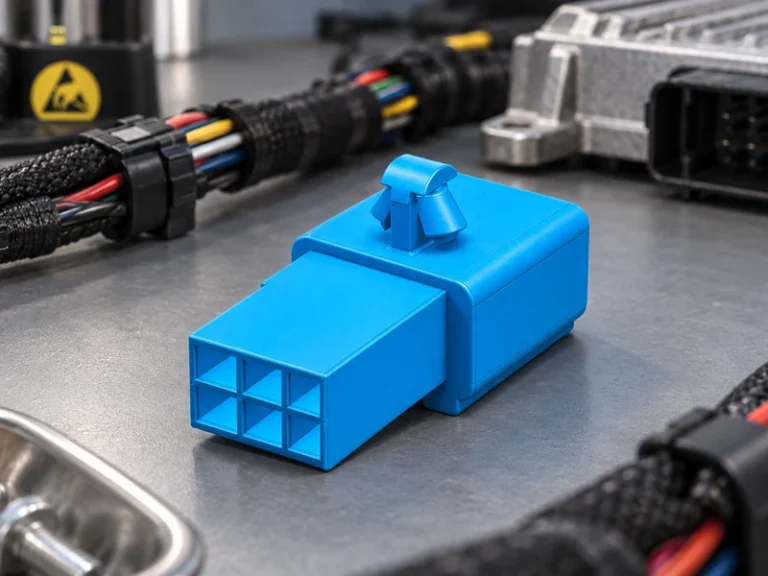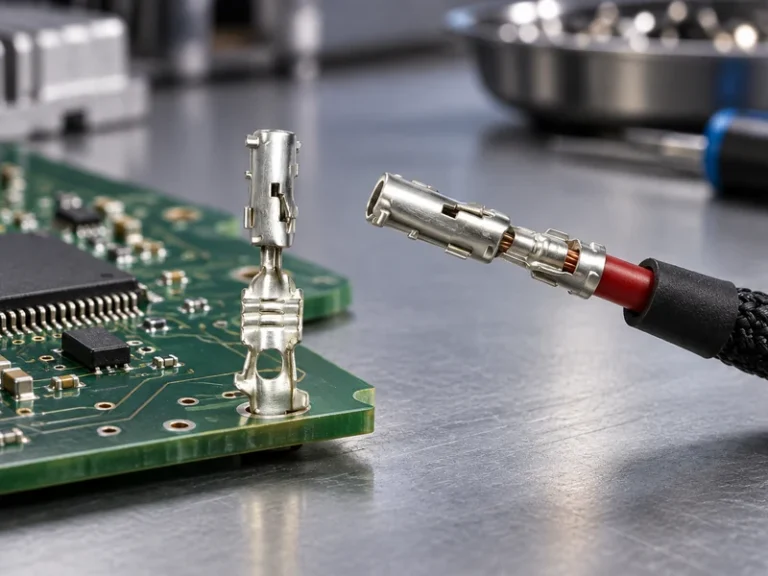


When a procurement lead in Pune, Maya Rao, received an approved harness sample, she substituted a lower-cost sealed connector for the production request; at the first mate, the seal sat visibly proud and the halves would not seat consistently. The composite scenario is fictional, but the lesson is practical: this was a specification and selection failure, not merely a bad product. Summary: choose automotive wiring harness connectors from the circuit, terminal, sealing, packaging and validation requirements together. SAE/USCAR-2 and IEC 60512 are test/specification references, not automatic product certificates. Recommended action: freeze a connector-interface checklist before comparing quotations.
A connector is the mechanical and electrical interface that lets a harness transmit power or signals while tolerating assembly, motion and its intended environment. The part number is only a starting point. A buyer also needs to establish the mating family, terminal system, keying, cavity population, wire range, secondary lock, backshell or dress details, and evidence required by the customer program. That discipline reduces the chance that a seemingly similar component changes the fit of the car wiring harness after drawings have been released.
Translate the vehicle requirement into an interface definition
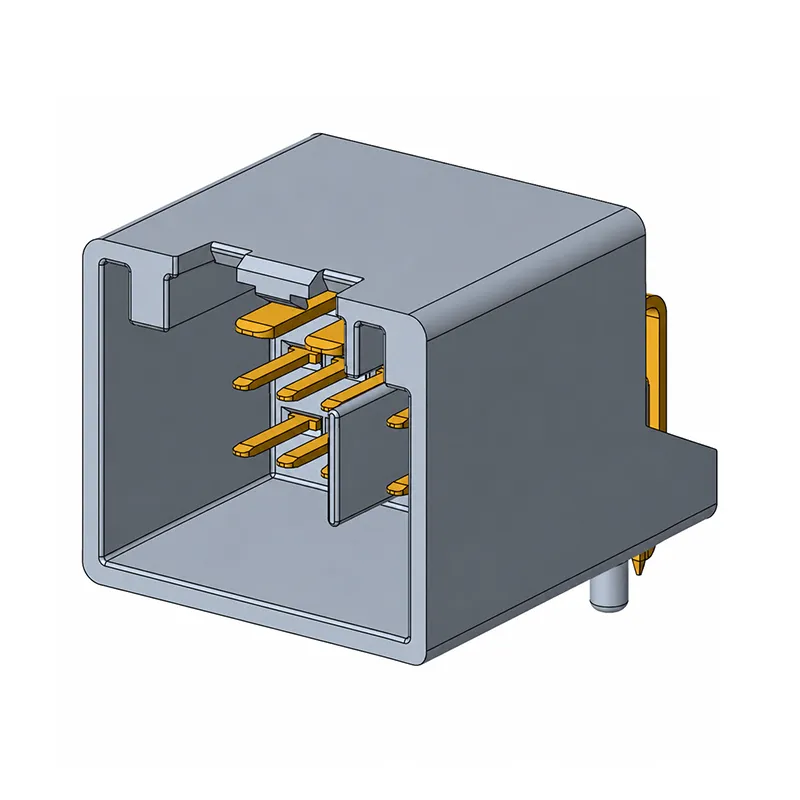
Start with function. A low-current sensor circuit, a power distribution circuit and a high-voltage subsystem can impose very different requirements on contact design, retention, creepage, shielding and service access. Count occupied and spare cavities separately; a six-position housing is not automatically suitable when the application requires a particular terminal or plug arrangement. Record wire cross-section in the drawing’s stated unit and confirm the matching terminal family rather than assuming any terminal that fits the cavity will perform correctly.
Then define the mating interface. Keying, polarization, latching direction and terminal-position assurance features prevent mis-mating and back-out, while color is generally a visual aid rather than the complete identity of the interface. IEC 60512 publishes test methods for electromechanical components used in electronic equipment, including connector-related methods; SAE/USCAR-2 provides performance requirements and test methods for automotive electrical connector systems. A sourcing package should state which document revision and which customer-specific requirements govern acceptance.
For a practical comparison, ask whether the proposed assembly includes housing, terminals, seals, cavity plugs and any required secondary lock. The answer establishes what is actually being quoted and helps a harness assembler calculate labor and missing-piece risk. A car connector that appears economical as a housing alone can become a higher-cost choice if its terminals, seals or insertion tooling are unavailable in the needed configuration.
Match sealing, materials and mechanical endurance to the use case
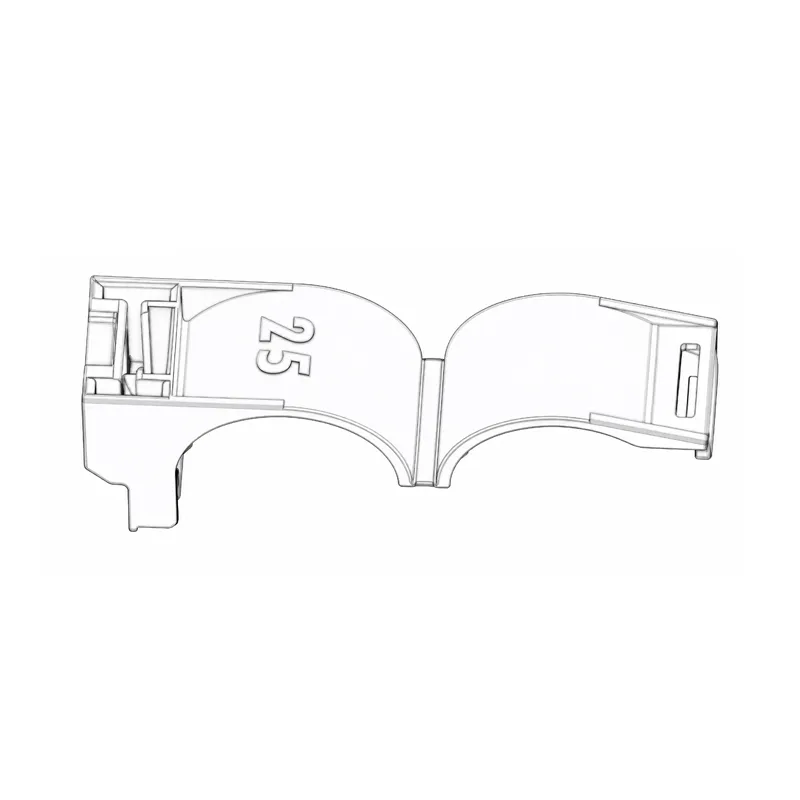
Sealing is an interface system: the wire seal, cavity plug, housing geometry, mating seal and assembly process must all work together. An unoccupied cavity may require a compatible plug; a wire outside the seal’s intended range can compromise the interface even when the housing looks correct. The Pune-style visible seal issue often originates in a mismatch between cable diameter, terminal geometry and seal design—not in an isolated molding defect.
Vibration, temperature cycling, fluid exposure and repeated mating can affect contact force, retention and sealing. SAE/USCAR-2 is useful when the program calls for an automotive connector-system reference, whereas IEC 60512 can be relevant for defined connector test methods. Neither citation removes the need to agree sample condition, test sequence, inspection criteria and lot traceability with the customer. Procurement teams should request the evidence relevant to their application instead of treating a generic standards mention as a pass/fail guarantee.
The right car connectors choice also considers serviceability. A repairable location may need an accessible latch and a documented depinning method; a protected module location may prioritize compact packaging. Review how the harness is routed and retained, because strain relief and bend radius can influence the connection even when electrical checks on a bench sample appear satisfactory.
Compare value beyond the quoted unit price
Unit price matters, but the commercial decision is usually the installed and approved cost. A lower quotation can add expense through terminal sourcing, manual insertion, rejected first articles, mating ambiguity or more complex incoming inspection. An illustrative—not predictive—calculation is to compare the quoted assembly cost plus required accessory parts and expected handling steps; it is not appropriate to assign a universal failure cost without program data. The useful result is a documented trade-off rather than a claim that one family is always cheaper.
| Decision dimension | Lower initial-price option | Specified interface option | Buyer check |
|---|---|---|---|
| Compatibility | May require separate confirmation | Mapped to the approved mating interface | Compare drawings, keys and terminals |
| Assembly efficiency | Accessory and tooling scope may be unclear | Components can be defined as a set | List housing, terminals, seals and locks |
| Durability evidence | Evidence may not match the duty cycle | Evidence can be requested against the program plan | Name the required method and sequence |
| Maintenance and returns | Interface uncertainty can raise rework exposure | Documented servicing supports consistent repair | Review extraction and replacement procedure |
| Total cost | Lower visible component cost | Potentially clearer validation and handling scope | Calculate with the same bill of materials |
Application mapping makes the comparison more concrete. The table below does not assign ratings; final suitability depends on the vehicle program’s drawings, environment and validation plan.
| Application | Interface priorities | Harness and assembly questions |
|---|---|---|
| Cabin electronics | Packaging, keying, service access | Confirm latch access and signal-circuit terminal selection |
| Engine-bay or exterior area | Environmental sealing, retention, material compatibility | Define seal, cavity-plug and fluid-exposure requirements |
| Chassis or moving assembly | Vibration resistance, strain relief, routing | Review clips, bend radius and test sequence |
| Power distribution | Terminal system, heat management, polarity control | Validate conductor range and mating parts as a system |
| Aftermarket repair | Identification, replaceability, installation instructions | Specify kit contents and terminal extraction process |
Use standards, documentation and supplier review correctly
IATF 16949 is a quality-management-system standard for organizations in the automotive supply chain; it is not a statement that every connector is automatically certified for every vehicle use. IEC 60512 and SAE/USCAR-2 are connector test/specification references, not automatic product certification. Their value lies in creating a common language for a program’s test plan, acceptance criteria and documentation. Marketing a component as compliant without defined scope or evidence can create commercial and warranty risk, particularly where destination-market rules or customer specifications apply.
A complete request for quotation should therefore include drawings, mating part numbers, circuit use, wire data, sealing context, annual demand assumptions, packaging expectations, sample stages, requested documents and any customer-specific validation plan. It should also identify whether the item is a component, a kit or a pre-terminated assembly. This lets suppliers identify discrepancies before tooling, purchase orders or harness build instructions lock them in.
A five-step selection guide for procurement and engineering
- Lock the mating interface: confirm housing family, positions, keying, latch, terminal system and secondary-lock requirements against the approved reference.
- Define circuit and wire needs: separate signal and power use, identify conductor range, and list every seal and cavity plug required for the car wiring harness.
- Set the application environment: state mounting location, expected exposure, vibration context, routing constraints and intended service approach.
- Request comparable evidence: specify the relevant SAE/USCAR-2 or IEC 60512 methods, program sequence and document format instead of accepting a standards label alone.
- Compare the delivered set: include terminals, seals, locks, packaging, tooling and support in the total-cost review.
In a controlled sourcing pack, automotive wiring harness connectors are evaluated as matched systems rather than interchangeable catalog items. That approach gives engineering a clear change-control point before parts reach the line.
For high-mix builds, car connectors also need a stable identification method across purchasing, stores and harness assembly. Each controlled change to a car wiring harness should preserve the approved mating reference, terminal specification and seal configuration.
For buyers seeking a supplier discussion, Wenzhou Shenji can be evaluated against the supplied credentials— IATF 16949, ISO 14001, ISO 45001 and an ISO 17025 (CNAS-compliant laboratory)—alongside its product documentation, configuration discussion and sample requirements. Examples such as the 2BK01 connector listing, the SJZ-XJR-25 connector listing, and the 336-YX connector listing can support an initial catalog-to-drawing review; they do not replace application validation.
Frequently asked questions
What types of automotive connectors are used in vehicles?
Vehicles use connectors for sensors, lighting, controls, power distribution, modules and harness junctions. Car connectors differ by cavity count, terminal style, sealing approach, keying and service needs. Selection should begin with the approved mating and circuit definition, not a visual similarity search.
How do you select sealing for an automotive connector?
Choose sealing by the installation environment and the full interface: wire diameter, wire seal, cavity plug, mating seal and housing must be compatible. Define which cavities are occupied and how the assembly is installed. Then have the proposed combination reviewed against the program’s test and inspection requirements.
When should car connector be considered?
A car connector should be considered whenever a vehicle circuit needs a separable electrical interface for assembly, service or module integration. The decision point is early enough to capture mating geometry, conductor details and sealing needs in the harness specification. Late substitutions should be treated as engineering changes, even if the parts look alike.
What vibration tests apply to an automotive connector?
The applicable vibration evaluation depends on the vehicle location, customer specification and connector system. SAE/USCAR-2 may be used where the automotive program calls for its performance requirements and test methods, while IEC 60512 contains relevant connector test methods. Confirm the exact method, sequence, sample condition and acceptance criteria before test planning.
References and the decision that prevents rework
- SAE/USCAR-2: Performance Specification for Automotive Electrical Connector Systems
- IEC 60512: Connectors for electrical and electronic equipment—tests and measurements
- IATF 16949 overview
- ISO 14001 environmental management overview
The strongest connector decision is the one that makes mating, assembly and validation predictable before the first production harness is built. When the specification is ready for review, contact Wenzhou Shenji to discuss the interface and documentation needed for the sourcing decision.