

A ring terminal, a ferrule and a contact inside a connector housing can all terminate stranded wire, but they do different jobs. Replacing one with another because the conductor fits can leave the equipment without the required clamping interface, retention or protection. The same problem appears when an outdoor enclosure is selected by its cover while cable entries and internal terminations receive little attention. Procurement and assembly teams need a decision sequence that starts with the receiving connection. This guide compares the main interfaces, explains wire and insulation checks, and separates corrosion protection from the electrical termination itself.
The short answer is to choose terminal types by the interface they must connect to, then confirm the conductor, tooling and environment. A ring attaches to an approved stud connection; a ferrule prepares a wire end for a compatible clamp; a housing contact needs its specified mating family. IEC 60352-2 addresses crimped connections within its scope, while IEC 60529 addresses enclosure protection classifications. Neither makes unrelated parts interchangeable. Before ordering, obtain the current component drawing and installation instructions, including conductor material, size, insulation diameter and any required protective accessories.
Which wire terminal fits the equipment connection?
Compare wire terminal types at the receiving interface first. A fork may provide useful service access, but only if the equipment permits its open tongue. A closed ring prevents sideways withdrawal while a fastener passes through the eye, yet it still needs correct clamping. Neither shape establishes a current rating.
| Termination | Receiving interface | What controls the choice? |
|---|---|---|
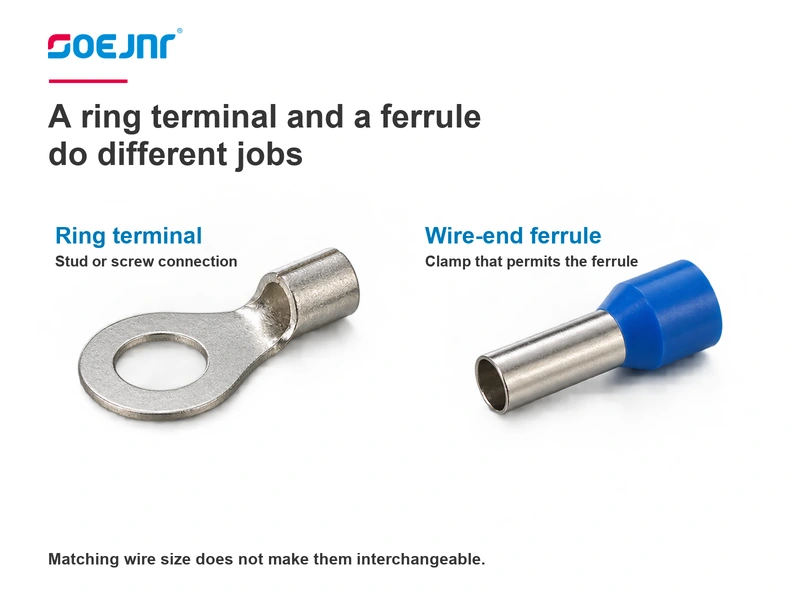
| Ring terminal | Approved screw or stud fastening | Eye diameter, tongue seating, barrel fit and fastening instructions |
| Fork terminal | Compatible clamping screw or stud | Permitted fork geometry, service access and retention requirements |
| Tab receptacle | Specified mating blade | Tab width, thickness, contact family and retention features |
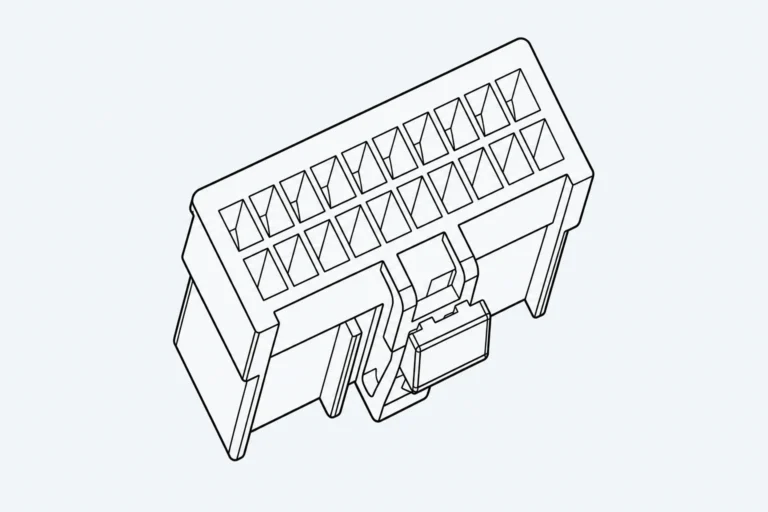
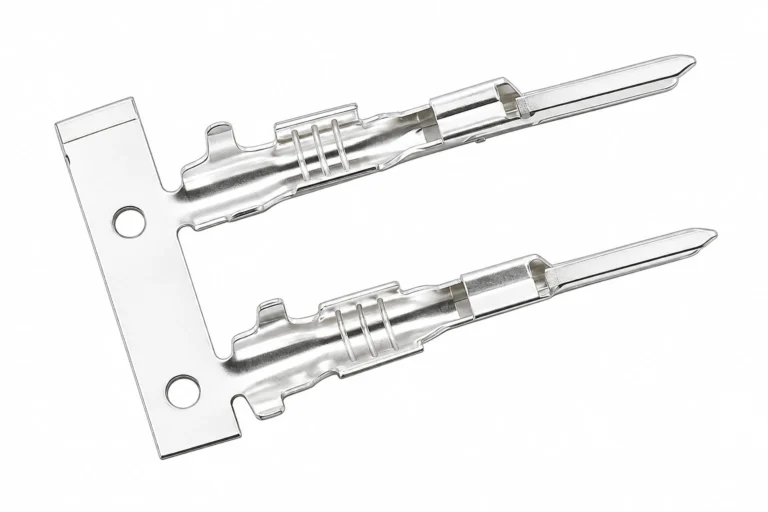
| Housing-mounted contact | Specified connector cavity and mating contact | Contact family, wire range, locking features and extraction method |
| Wire-end ferrule | Clamp that permits the selected ferrule | Conductor size, sleeve length, finished crimp profile and clamp acceptance |
| Butt splice | Another permitted conductor | Wire combination, barrel preparation and insulation or sealing system |
These distinctions prevent a common purchasing error: specifying a terminal only as “insulated” or “for stranded wire.” For related mating-system differences, see the electrical connector types guide. Use part numbers and drawings when names such as “spade” have more than one meaning.
What wire details are needed before choosing a crimp terminal?
A purchase description such as “crimp terminal wire connection” is incomplete. Record conductor material, cross-section or AWG, strand construction and insulation outside diameter. The conductor barrel and insulation support perform different functions and may have different acceptance ranges.
Do not remove strands to fit a smaller barrel, fold a small wire back to fill a larger one, or put two conductors into one barrel without specific approval. A nearby AWG-to-metric conversion does not establish compatibility. Aluminum conductors require terminals expressly suitable for them and the specified preparation method; adding contact compound does not qualify an unsuitable copper-wire terminal.
After defining the crimp terminal wire combination, identify its die, locator and setup requirements. A ratchet tool can complete a repeatable stroke with the wrong die. Select tooling from the application specification and use the terminal crimping tool guide to frame the questions that need a part-specific answer.
What changes when a terminal sits in an outdoor box?
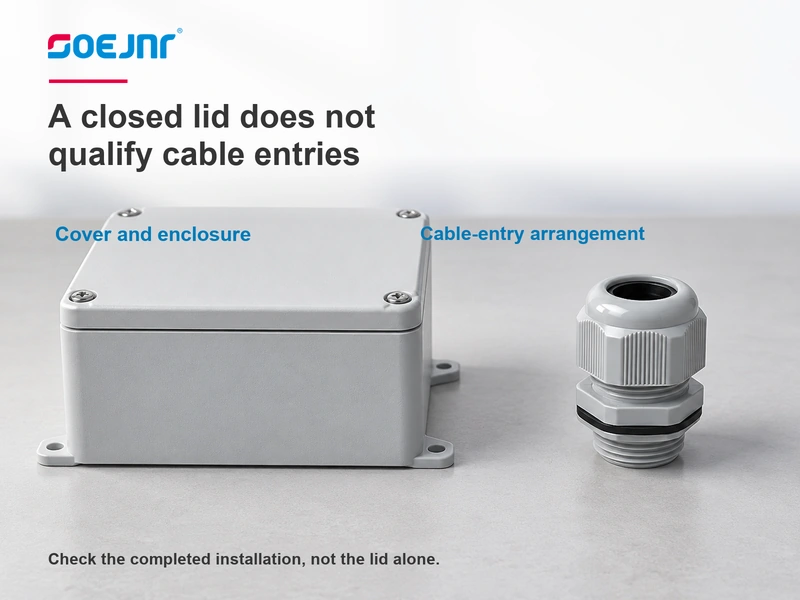
A search for “terminal box outdoor” should lead to two separate reviews: the enclosure system and the connections inside it. A suitable lid does not establish the protection of cable glands, plugs, mounting holes or a completed installation. Condensation can also occur inside an enclosure, so protection against external water and management of internal moisture need separate consideration.
| Condition | Evidence to request | What appearance cannot prove |
|---|---|---|
| Rain or wash exposure | Enclosure classification and assembly instructions covering entries and covers | A gasket alone does not establish an installed-system rating |
| Condensation | Site conditions and an approved moisture-management arrangement | A closed enclosure is not automatically dry inside |
| Salt or chemicals | Suitability of metal finishes, insulation, seals and enclosure materials | Silver-colored plating does not identify its composition or resistance |
| Temperature and sunlight | Component temperature limits and relevant exposure data | A plastic housing is not automatically suitable for outdoor ultraviolet exposure |
| Cable movement | Gland, clamp and strain-relief instructions | A terminal should not carry the unsupported cable weight |
IEC 60529 classifies degrees of protection provided by enclosures within its scope; consult the IEC catalogue and the exact enclosure documentation. It is not a blanket corrosion, ultraviolet or condensation guarantee. For a “terminal box outdoor” enquiry, state the exposure and completed entry arrangement rather than asking only for a high-looking code.
How should installation and inspection change between terminal types?
Different terminal types move the critical inspection point. A stud connection needs correct tongue seating and controlled fastening. A clamp connection needs accepted conductor preparation and full insertion. A housing contact needs both an acceptable conductor crimp and correct seating in its cavity. Passing one check does not establish the others.
- Verify the wire, termination and receiving component against the released drawing.
- Prepare the wire to the specified strip length without damaging strands.
- Crimp only when required, with the approved tooling and acceptance criteria.
- Complete the specified clamping, mating or contact-locking operation.
- Check circuit identity, routing, strain relief and required mechanical or electrical tests.
Record the approved crimp terminal wire combination in work instructions. Define destructive pull tests separately from non-destructive seating checks, and do not install tested-to-failure samples. Current continuity does not prove adequate performance under load or environmental exposure.
How should a supplier enquiry describe the complete connection?
List acceptable wire terminal types, the mating part, wire construction, electrical conditions and operating environment. Include drawings, tooling constraints, inspection criteria and change-notification requirements. For a “terminal box outdoor” project, keep enclosure and terminal documentation identifiable as separate items.
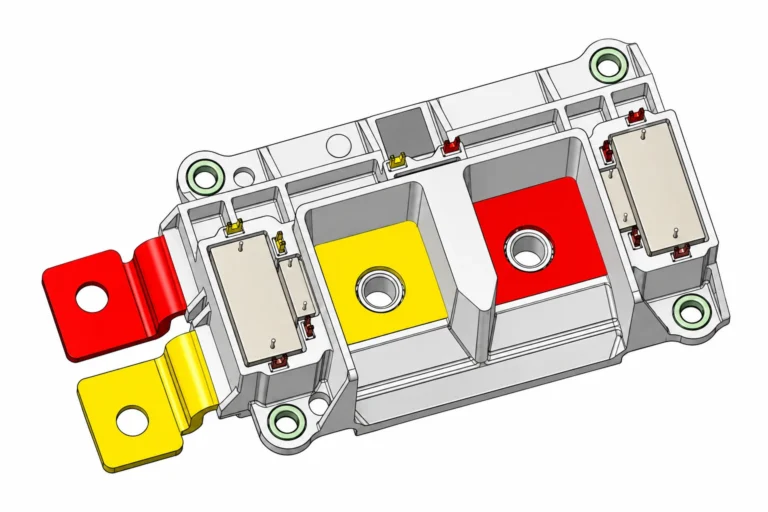
The website’s real automotive connector photographs show external housing geometry, not a complete qualified wire termination. Wenzhou Shenji’s automotive connector products can support component identification, but a photograph does not reveal conductor range, crimp settings or an assembled environmental rating.
What do buyers ask about corrosion, insulation and removal?
How do you prevent corrosion in a wire terminal?
Use compatible conductor and terminal materials, an appropriate documented finish and protection suitable for the exposure. Keep moisture and contamination out using the specified assembly system. Apply grease or inhibitors only where permitted, and investigate the source of corrosion rather than treating the visible surface alone.
What insulation options are available for wire terminals?
Options include product-specific sleeves, separate covers, heat-shrink systems and an insulating connector housing. Insulation and environmental sealing are different functions. Check temperature, voltage and chemical suitability from the exact product data.
How does wire terminal types change installation requirements?
The chosen wire terminal types determine whether assembly needs crimping, controlled fastening, clamp insertion or contact locking. They also define strip length, tool access and removal procedures. Do not transfer an instruction from one interface to another merely because the wire gauge matches.
What is the safest way to remove a wire terminal?
Isolate relevant energy sources and verify the safe state before work. Use the manufacturer’s release or extraction procedure, and avoid pulling on the wire. Opening and re-crimping a used barrel is generally not an approved repair; replace it unless an explicit manufacturer procedure allows otherwise.
Which references support these selection checks?
- IEC Webstore: IEC 60352-2 for crimped connections and IEC 60529 for enclosure protection classifications; check current editions and exact scope.
- 29 CFR 1910.303, Cornell Legal Information Institute: conductor suitability, electrical connections and equipment use in covered U.S. workplaces.
- 29 CFR 1910.333, Cornell Legal Information Institute: electrical work practices, including de-energizing and verification. Local requirements elsewhere must be checked separately.
Conclusion: Which terminal should be specified first?
The receiving interface should determine the shortlist of terminal types. Start with the stud, clamp or connector family, then match conductor construction, insulation diameter and operating conditions. Approve tooling and installation instructions before releasing the purchase order. For outdoor installations, review the complete enclosure and cable-entry arrangement separately from the electrical termination; an insulating sleeve or housing photograph cannot establish protection against moisture. Keep inspection criteria tied to the exact component combination and replace damaged parts through an approved repair procedure. Wenzhou Shenji supplies automotive connector components; send the mating-interface drawing, wire details and exposure conditions to request the documentation needed for a specific selection.