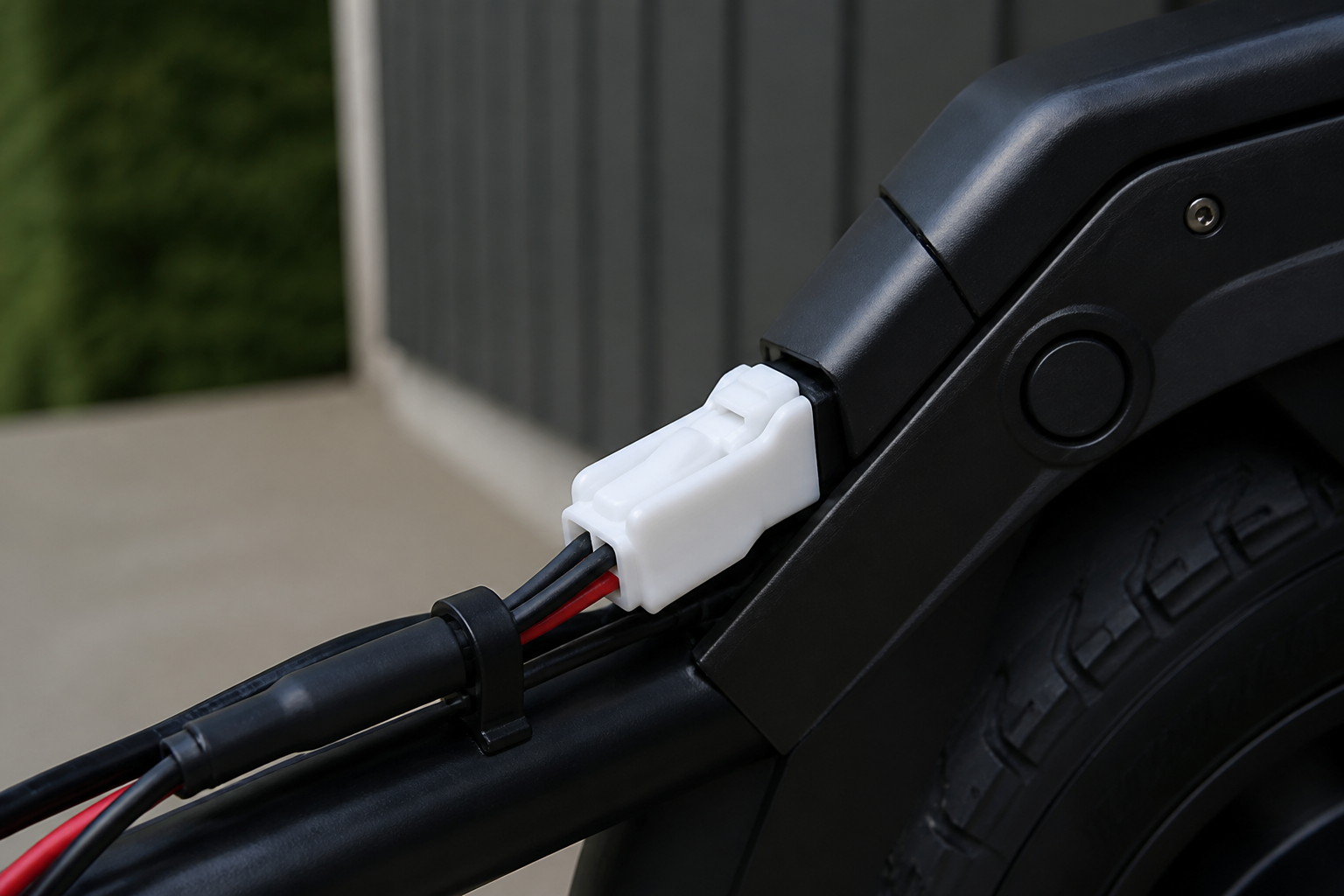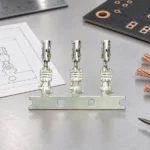


When a harness engineer in Ningbo received the first pilot e-bikes from a contract assembler, she re-seated a battery plug before the morning road test; within minutes, the display reset under acceleration and the plug body felt unusually warm. The visible failure looked like a defective controller, but the review found a specification problem: terminal geometry, conductor size, retention and installation clearance had never been checked as one system.
Summary: Select a connector from the electrical load, mating interface, wire cross-section, available envelope and expected environment—not from voltage alone. A 48 V or 52 V pack can still create a high-current, high-heat joint if contact resistance and crimp quality are poorly controlled. Use a documented sample build and test plan; SAE/USCAR-2 and IEC 60512 provide useful test frameworks, while the final requirement must match the vehicle, destination market and claim. This guide explains how procurement and harness teams can make that decision repeatable.
Light-electric-vehicle connections sit between an energy source, a protection strategy and a moving harness. They may carry power, low-voltage signals, interlock circuits or all three. That is why a familiar plug shape is not a complete specification. The right choice manages voltage, continuous and peak current, mating cycles, polarisation, service access and the realities of assembly.
Design considerations for E-Bike Connectors
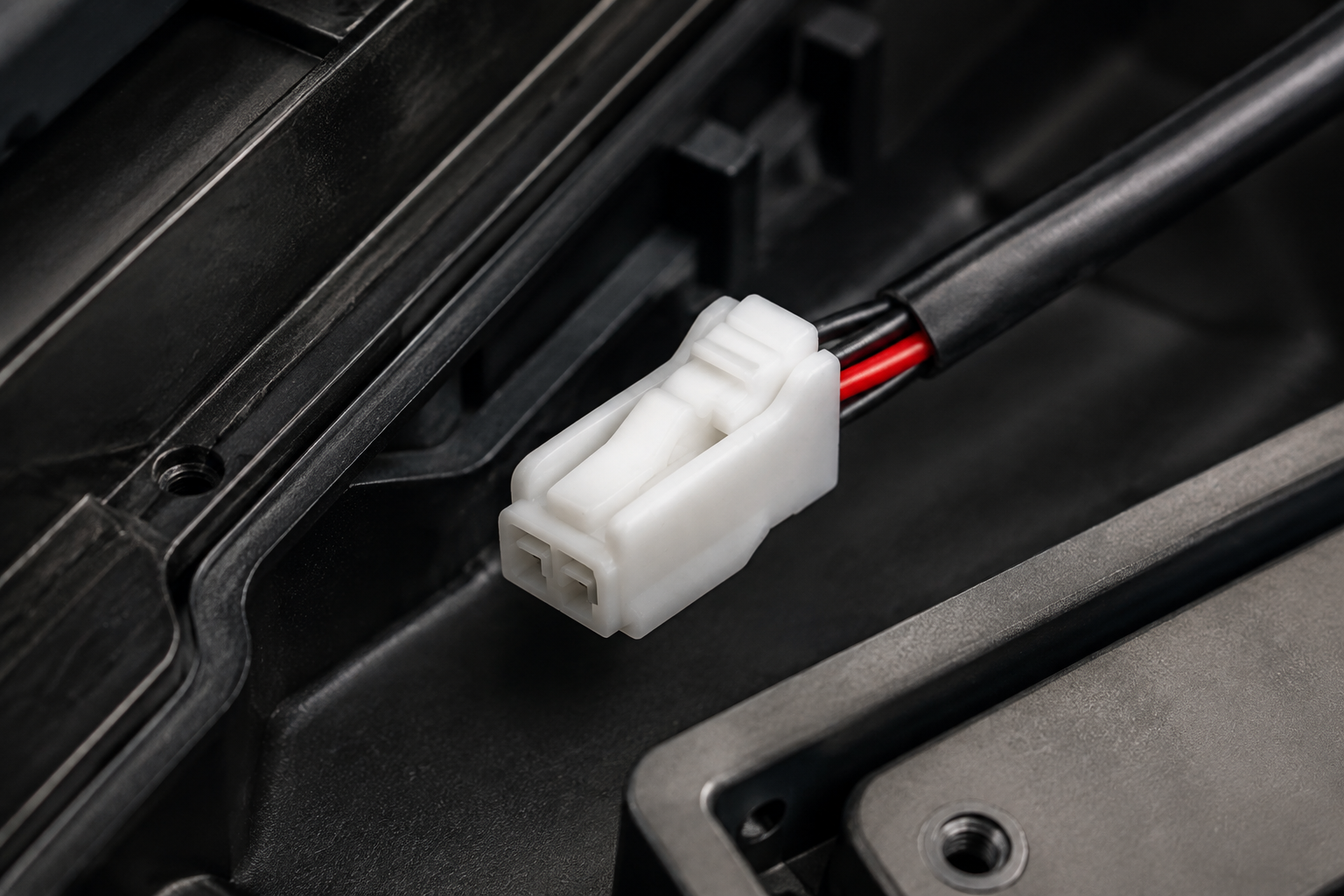
Start with an interface map. List each circuit, nominal voltage, expected continuous current, short-duration peak current, conductor material and cross-section, then identify whether the joint will be mated by an operator, a service technician or an automated station. For a 36 V, 48 V or 52 V battery system, voltage is only one input; the contact system must also dissipate heat generated by current and resistance. The relationship is simple—power loss rises with the square of current—so a small resistance increase can matter at a loaded battery outlet.
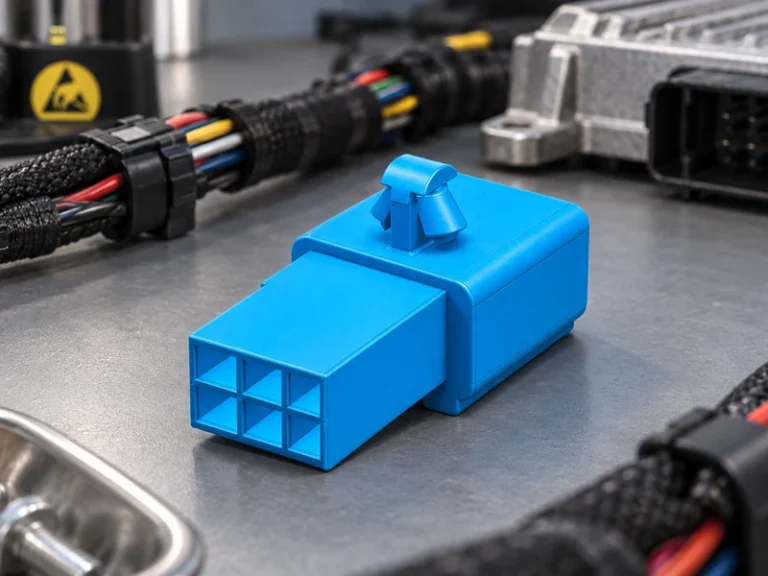
ebike connector types are commonly grouped by function: compact signal connectors, low-to-medium current accessory connectors, battery discharge interfaces and high-current serviceable power connectors. A procurement drawing should specify the mating half, keying, gender convention, terminal family, wire range and permitted cable exit direction. It should not rely on a catalogue photograph or a generic product name.
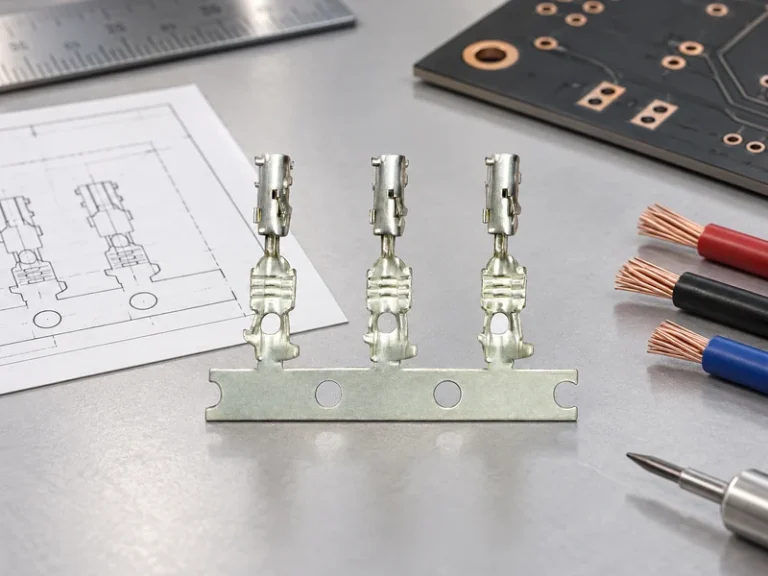
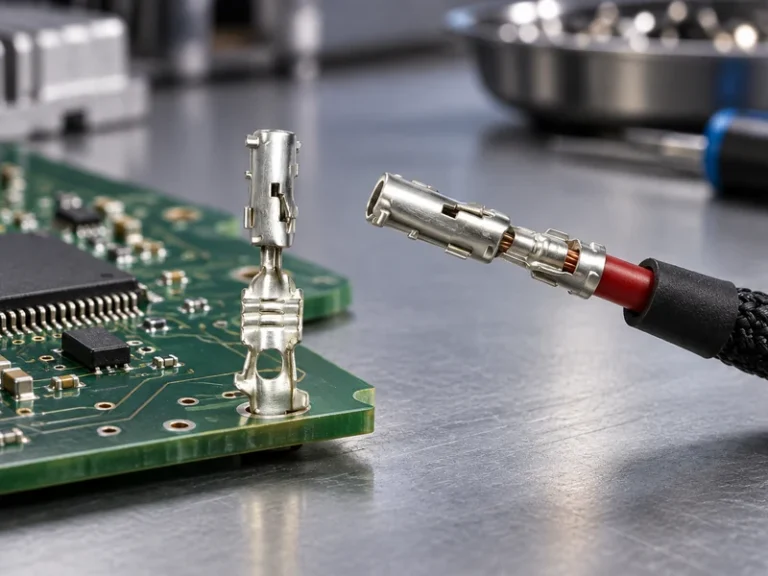
For ebike connectors, conductor size and terminal acceptance must be evaluated together. A larger wire can reduce conductor loss but may not fit the terminal barrel, boot or bend radius. Conversely, forcing a small wire into a large barrel can undermine crimp compression and pull-out performance. IEC 60512 is a series of connector test methods, not a blanket product approval; its applicable tests can inform contact resistance, mechanical operation, vibration or environmental evaluation when the programme defines the method and acceptance criteria.
Make the package measurable before tooling
Reserve room for the connector body, backshell or seal, wire bend radius, latch travel and a hand or service tool. Measure in millimetres from the installed position, rather than from an unconstrained CAD model. A practical sample review should include at least the fully seated, half-mated and un-mated states; this exposes collisions with battery trays, controller housings and frame tubes before a harness drawing is released.
Sealing and vibration resistance of E-Bike Connectors
Water, wash-down spray, dust, road salt and frame vibration do not act independently. A seal can be effective at first assembly yet lose performance if a cable is pulled, a secondary lock is omitted or a connector is repeatedly mated with contamination on its interface. Specify the expected exposure, mounting orientation and maintenance practice. If an ingress-protection rating is needed, state the exact rating, test configuration and whether it applies when mated; do not assume that a sealed-looking connector carries a particular rating.
Validation should reproduce the installed joint. A useful programme combines visual inspection, crimp-height verification, contact-resistance measurement, temperature rise under the defined load, vibration exposure and re-measurement after conditioning. SAE/USCAR-2 is a performance specification for automotive electrical connector systems and offers a structured reference for such durability work; it does not by itself certify an e-bike assembly or prove compliance in every market.
| Decision dimension | Compact signal interface | Battery power interface | Serviceable high-current interface |
|---|---|---|---|
| Primary concern | Pin count and signal integrity | Heat, polarity and retention | Heat, repeated service and safe handling |
| Packaging tendency | Small body; limited wire range | Moderate envelope; controlled cable exit | Larger envelope; allow tool and bend clearance |
| Durability focus | Latch security and vibration | Sealing, contact resistance and strain relief | Mating-cycle wear, interlock and strain relief |
| TCO risk if underspecified | Intermittent signals and diagnosis time | Heat-related returns and harness rework | Field-service delay and replacement cost |
This comparison is directional, not a rating table. The hidden cost is often late rework: an inexpensive interface can become costly when the battery housing, harness length or service procedure must change after validation. For that reason, ebike battery connectors should be reviewed on a built sample, with the intended wire, seal and mating counterpart, rather than assessed as loose components.
When to use E-Bike Battery Connector
An ebike battery connector is appropriate where the pack must connect safely and repeatedly to a vehicle harness, controller or removable battery dock. Choose a dedicated power interface when the circuit carries traction power or needs positive keying and robust retention; keep it separate from low-current data contacts unless the selected multiway system is designed, specified and validated for the combined duty.
Size the ebike battery connector from the complete electrical and mechanical duty. Define continuous and peak current separately, ambient temperature near the battery compartment, permitted temperature rise, wire cross-section, number of loaded adjacent circuits and mating-cycle expectation. The datasheet rating is not portable across every wire size or enclosure. An illustrative review might compare a 10 A continuous auxiliary circuit with a 30 A discharge circuit; both can be 48 V, but their terminals, conductors, protection and heat assessment may be materially different.
| Input to record | Why it changes the choice | Build-stage check |
|---|---|---|
| Voltage and continuous/peak current | Sets insulation, contact and thermal requirements | Load the assembled circuit and record temperature rise |
| Wire cross-section and insulation OD | Determines terminal barrel and seal compatibility | Verify crimp dimensions and retention on production-intent wire |
| Space envelope and cable exit | Controls latch access and bend strain | Check seated, half-mated and service positions in the vehicle |
| Water, dust and vibration exposure | Determines seal and retention strategy | Condition the fully assembled harness, then inspect and re-test |
In this phase, ebike battery connectors should have a controlled part number for each half and terminal, plus a clearly linked harness revision. That traceability prevents a purchasing substitution from quietly changing the mating interface. The same discipline is valuable for connector families that look interchangeable but use different keyways, plating or wire ranges.
Sourcing and validation for E-Bike Connectors
Build a sourcing package that includes the electrical specification, mating drawing, approved wire range, crimp tooling, inspection method, environmental assumptions and required documents. Ask the supplier which test method supports each stated property, whether the result is for the component or the assembled harness, and what sample configuration was used. That makes ebike connectors easier to compare than a list of unqualified ratings. A formal comparison of ebike connector types should also state the precise mating counterpart and approved wire range.
For automotive-adjacent programmes, IATF 16949 describes requirements for an automotive quality management system; it is not a performance certification for an individual connector. ISO 14001 addresses environmental management systems, not waterproofness, electrical safety or connector life. Request evidence that is relevant to the product and process, and phrase marketing claims only as broadly as that evidence permits. Requirements may also differ by destination market, vehicle classification and whether the product is sold as an original-equipment part or aftermarket replacement.
Wenzhou Shenji, founded in 2010 in Wenzhou, Zhejiang, supports B2B buyers with automotive connector and component sourcing conversations. Teams can review relevant application needs, compare the available product range and confirm the supplier background on the company profile. For a new programme, submit the interface drawing and validation expectations before treating a sample as production-ready.
Selection checklist and installation sequence
- Freeze the electrical duty: nominal voltage, continuous current, peak current, circuit function and allowed temperature rise.
- Match the terminal to the actual conductor and insulation diameter; validate the crimp with the intended tooling, not a visual-only check.
- Confirm keying, polarity, latch travel, seal position and service access on a physical build before finalising the housing.
- Use a test plan tied to the installed environment, then retain part numbers, build settings and acceptance records for repeat orders.
That sequence turns ebike connector types from a catalogue selection into an engineering decision. It also limits total cost: the first approved interface should reduce later harness changes, field diagnosis and avoidable replacement activity rather than merely minimise the initial unit-cost tendency. It is equally useful when qualifying ebike battery connectors for repeat production.
How do you match a battery terminal connector to a wiring harness?
Match the terminal system to the exact mating half, circuit function, wire cross-section, insulation diameter and approved crimp tooling. Then check keying, polarity, retention and seal compatibility on an assembled harness. A catalogue terminal that fits physically is not enough; use the supplier drawing and defined crimp inspection criteria.
What temperature range should a battery terminal connector support?
The required range comes from the installed vehicle environment and self-heating at the defined current, not from a generic e-bike label. Consider ambient heat near the pack or controller, solar loading, peak-load duration and the permitted temperature rise. Confirm the component specification and validate the assembled circuit under representative conditions.
How does ebike connectors affect installation space?
Connector size affects more than the cavity outline: installers need room for cable bend, latch travel, strain relief, the mating action and any service tool. Tight packaging can transfer load to the terminal or prevent full seating. Model and inspect the connector in seated, half-mated and service positions before release.
What causes battery terminal connector failures in vehicles?
Common causes include incorrect terminal-to-wire matching, inadequate crimp control, incomplete seating, damaged seals, vibration-driven fretting, contamination and heat from elevated resistance. The corrective action should follow evidence from the returned assembly, such as visual condition, crimp measurements and contact-resistance comparison. Replacing the connector without finding the process cause can repeat the failure.
References
A connector succeeds when its interface, conductor, installation space and validation evidence agree—not when it merely mates on the bench. When your team is ready to review an ebike battery connector interface or sourcing brief, contact Wenzhou Shenji with the drawing, wire specification and intended operating conditions.