

When an electrical installer routes nonmetallic-sheathed cable into a junction box, a connector that looks close enough can still leave the jacket poorly retained, the entry edge exposed, or the enclosure opening mismatched. The visible failure may be a loose cable after service work, but the root cause is usually selection: the fitting was chosen by appearance instead of cable construction, entry geometry, and the enclosure manufacturer’s instructions. A plastic NM cable connector should therefore be evaluated as a cable-entry and retention component, not as a generic plastic clip. This guide explains how to check the cable jacket, box entry, strain relief, material environment, installation evidence, and limits on interchangeability before placing an order.
Summary: Choose an NM cable connector only after confirming the cable type and outside-jacket range, the enclosure or knockout entry, and the connector’s retention method. In the United States, NEC 314.17 addresses protection and securing of conductors entering boxes, while UL 514B covers the performance framework for conduit, tubing, and cable fittings; neither source makes all products interchangeable. The practical next step is to record the cable marking, measure the usable entry, review the fitting instructions, and verify that the installed jacket is held without crushing or exposing conductors.
What is a plastic NM cable connector used for?
A plastic NM cable connector is a fitting used where a nonmetallic-sheathed cable enters an electrical box, enclosure, or similar housing. Its mechanical job is to locate the cable at the opening, protect the jacket from the entry edge, and provide a specified method of retention. Electrical continuity is provided by the conductors and their terminals; the connector does not replace a terminal, splice device, overcurrent device, or bonding method.
“NM” describes a cable family rather than one universal outside diameter. Common cable markings can identify conductor count, conductor size, and a grounding conductor, but the finished jacket dimensions and construction still need to be checked against the fitting documentation. A connector that accepts one cable construction is not automatically suitable for another cable, even if both are casually called Romex in the field.
How do you match the cable jacket and enclosure entry?
Start with the cable, not the connector color
Read the cable jacket marking and the project wiring schedule first. Record the cable family, conductor arrangement, and any outer diameter or range stated by the cable manufacturer. The connector selection should reference that range directly. A white housing or a familiar “Romex connector plastic” shape is not evidence of a correct fit; color is usually an identification or finish choice, not a dimensional standard.
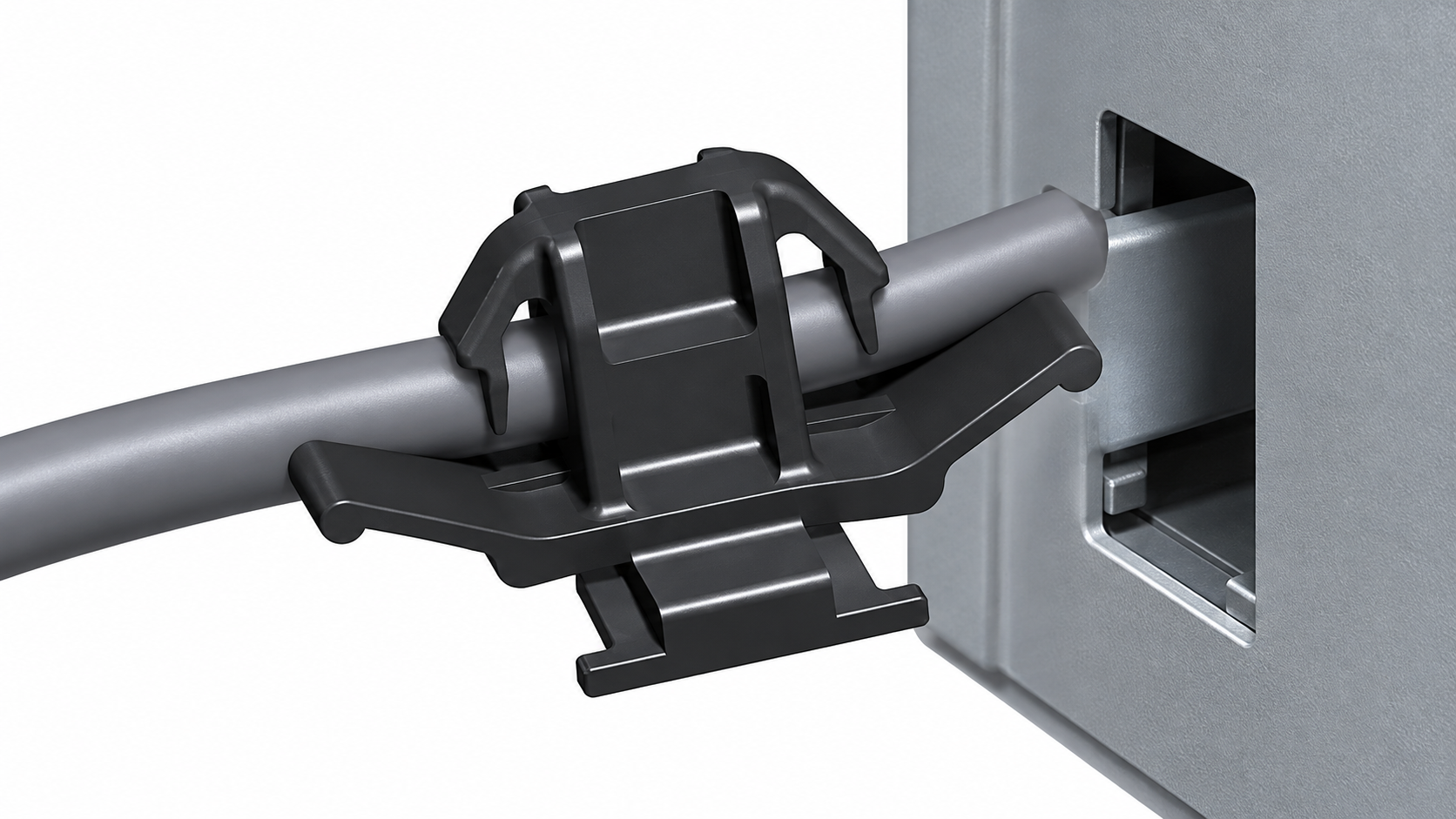
Then compare the connector’s cable path with the actual jacket. The jacket should pass through the entry without scraping, folding into the knockout, or being compressed so aggressively that the cable deforms. If the fitting uses a clamp, check where the clamp bears; it should retain the jacket as instructed rather than press on individual insulated conductors.
Confirm the box or enclosure side
Measure or identify the enclosure opening and the entry style specified by the enclosure maker. A connector may be intended for a particular knockout, threaded opening, snap-in arrangement, or locknut system. The panel thickness, opening edge, and available clearance can affect whether the retaining feature seats fully. The romex connector plastic part must be compatible with both sides of the interface: cable on one side and enclosure entry on the other. For broader cable-entry terminology, see this cable connector selection guide.
NEC 314.17 is a useful compliance checkpoint because it addresses protection and securing where conductors enter boxes. It does not provide a blanket approval for an unlisted or unverified fitting. The installation still has to follow the adopted code, the enclosure listing, and the connector instructions in the destination jurisdiction.
Which retention and strain-relief features matter?
Retention can be created by a clamp, a snap-in body, a threaded body with a locknut, or another design described in the product instructions. These forms should not be treated as equivalent. A snap-in fitting may depend on a particular panel thickness and hole edge; a threaded fitting may depend on thread engagement and locknut access; a clamp style may depend on tightening sequence and the stated cable range.
Ask the supplier what the fitting is designed to retain and what installation action creates that retention. Useful evidence includes an installation drawing, cable range, panel or knockout requirements, tightening guidance where applicable, and inspection criteria. Avoid claims such as “universal strain relief” unless the supplier provides a defined range and test basis. UL 514B is a relevant product standard for cable and conduit fittings, but the exact marking, listing, and scope must be checked for the product and market.
How do material and environment affect a plastic NM cable connector?
Plastic can be suitable for an NM cable entry when its material and design match the installation environment. Review exposure to temperature, moisture, ultraviolet light, oils or cleaning agents, impact, and vibration. An indoor residential box and an outdoor or industrial enclosure can impose different material and sealing requirements. Do not infer weather resistance, flame performance, or temperature capability from a generic polymer description or from a white finish.
Where the cable enters a listed enclosure, confirm that the connector’s intended use and markings align with that enclosure and the local electrical code. If a seal, gasket, or threaded interface is required for the enclosure’s environmental rating, a basic push-in fitting may not provide it. Conversely, adding a seal or clamp that the connector was not designed to use can change the load path and invalidate the installation instructions.
What should buyers compare before ordering?
| Decision point | What to verify | Why it matters |
|---|---|---|
| Cable compatibility | Exact cable family, jacket construction, and documented outside-diameter range | Prevents loose retention, jacket damage, and forced assembly |
| Enclosure entry | Knockout or hole form, panel thickness, thread or snap-in requirement, and clearance | Ensures the connector seats and remains retained at the box wall |
| Retention method | Clamp, snap-in, locknut, or other specified mechanism and its installation action | Defines how movement is controlled during service and handling |
| Environment | Indoor/outdoor location and documented temperature, moisture, UV, chemical, or impact limits | Avoids applying a fitting outside its evidence and marking scope |
| Inspection evidence | Instructions, markings, listing information where required, and sample fit check | Creates a traceable procurement and installation decision |
How do you select among common plastic NM connector forms?
| Connector form | Typical selection question | Boundary to confirm |
|---|---|---|
| Snap-in plastic connector | Does the body fit the knockout and panel thickness without tools? | Retention may depend on the hole edge and panel range; verify the specified opening. |
| Clamp-style plastic connector | Does the clamp bear on the cable jacket across the documented range? | Do not tighten by feel alone; follow the supplied assembly and inspection guidance. |
| Threaded plastic connector | Is there enough access for the body, thread engagement, and locknut? | Check enclosure wall thickness, thread form, and any sealing requirement. |
| Sealed or gasketed entry | Does the entry need environmental protection beyond basic cable retention? | Confirm the stated rating and cable range; a gasket is not proof of a complete enclosure rating. |
Which standards and documents should be checked?
- NFPA 70 (National Electrical Code), Article 314.17: Check the adopted edition and local amendments for requirements concerning protection and securing of conductors entering boxes and fittings.
- UL 514B, Conduit, Tubing, and Cable Fittings: Use the current edition and the product’s actual listing or certification record to understand applicable construction and performance scope. The standard is not a universal interchangeability statement.
- Enclosure and cable manufacturer instructions: These documents define the permitted entry, cable range, installation method, and environmental boundaries for the specific assembly.
Commercial consequences of an unsupported claim can include failed incoming inspection, rework, delayed approval, or rejection by an authority having jurisdiction. A supplier should be able to identify the applicable standard, product marking, revision-controlled drawing, and evidence for the intended market instead of offering only a generic material or color description.
What is a practical selection and installation checklist?
- Photograph or transcribe the cable jacket marking and record the cable’s documented outside diameter or range.
- Identify the enclosure opening, panel thickness, entry style, and any required locknut, gasket, or seal.
- Request the connector drawing and instructions; compare every interface dimension and stated environmental limit.
- Build a sample assembly using the production cable and enclosure material. Check full seating, jacket retention, conductor protection, and clearance before releasing a batch.
- Keep the approved connector description, revision, supplier evidence, and inspection criteria with the purchasing record.
Wenzhou Shenji supplies connector and terminal categories for OEM and industrial sourcing. Buyers evaluating a cable-entry requirement can review the connector product directory and request the drawing, cable range, and application evidence for the intended assembly. A romex plastic connector should be evaluated with the same interface discipline used for other electrical connector types; a product family description is only a starting point, and final approval depends on the specific part and destination-market requirements.
Frequently asked questions
What is a plastic NM cable connector used for?
It retains and protects a nonmetallic-sheathed cable where the cable enters a box or enclosure. The connector must match the cable jacket and the enclosure opening; it does not replace electrical terminals or splice devices. Check the adopted code and the fitting instructions before installation.
How do you choose a connector for the cable jacket and enclosure entry?
Start with the cable marking and documented outside-diameter range, then match the connector to the knockout or hole, panel thickness, and retention method. Confirm that the jacket is held without crushing and that the entry edge cannot abrade it. A sample fit check using the production cable is the most useful final verification.
Are Romex connector plastic parts interchangeable across cable sizes?
No general interchangeability rule should be assumed. Parts that look similar may have different cable ranges, panel requirements, or retention features, and the term Romex is also used informally for more than one cable configuration. Approve interchangeability only when the supplier documentation and the enclosure instructions identify the same cable and entry conditions.
What should be checked before installing white plastic electrical connectors?
Check the cable range, opening and panel fit, retention method, environmental limits, markings, and installation instructions. White color is not evidence of a particular listing, temperature range, or moisture rating. Inspect the completed entry for full seating, jacket support, conductor protection, and movement control; the same check applies to white plastic electrical connectors used in other cable-entry layouts.
References
- NFPA 70, National Electrical Code, current adopted edition and local amendments, Article 314.17.
- UL 514B, Conduit, Tubing, and Cable Fittings, current edition and applicable product listing scope.
- OSHA 29 CFR 1910.303, general requirements for electrical installations where the workplace rule applies.
Conclusion
The right plastic NM cable connector is the one that matches the complete entry system: cable jacket, enclosure opening, retention method, environment, and documented installation procedure. Start by confirming the cable and box conditions, then compare the connector drawing and evidence, and finally validate a production-like sample before ordering at scale. Do not treat color, a familiar trade name, or a similar-looking part as proof of interchangeability, and do not skip the adopted code or enclosure instructions. Wenzhou Shenji can support the sourcing stage with connector-category information and application documentation; begin with the product directory and contact the team with the cable marking, entry details, and target market so the selected part can be checked against the real decision boundary.